 DE
DE

OpenClaw in Hospitality: Game Changer for Hotel Sales — or the Wrong Hype at the Wrong Time?
OpenClaw is the most-discussed AI project of the year. Research institutions like MIT — one of the world's leading technology universities — are analysing it, industry giants like AWS are positioning themselves around it, and on GitHub, the world's largest developer platform, the project has accumulated over 300,000 stars — a measure of how many developers have flagged it as relevant. Yet while the tech world debates autonomous AI agents, hoteliers face a more fundamental question: which of this delivers real operational and commercial value in Group & Convention Sales — and where does a more differentiated view make sense?
This article sets out what Agentic AI in hospitality actually means — and where hotels should focus their attention.
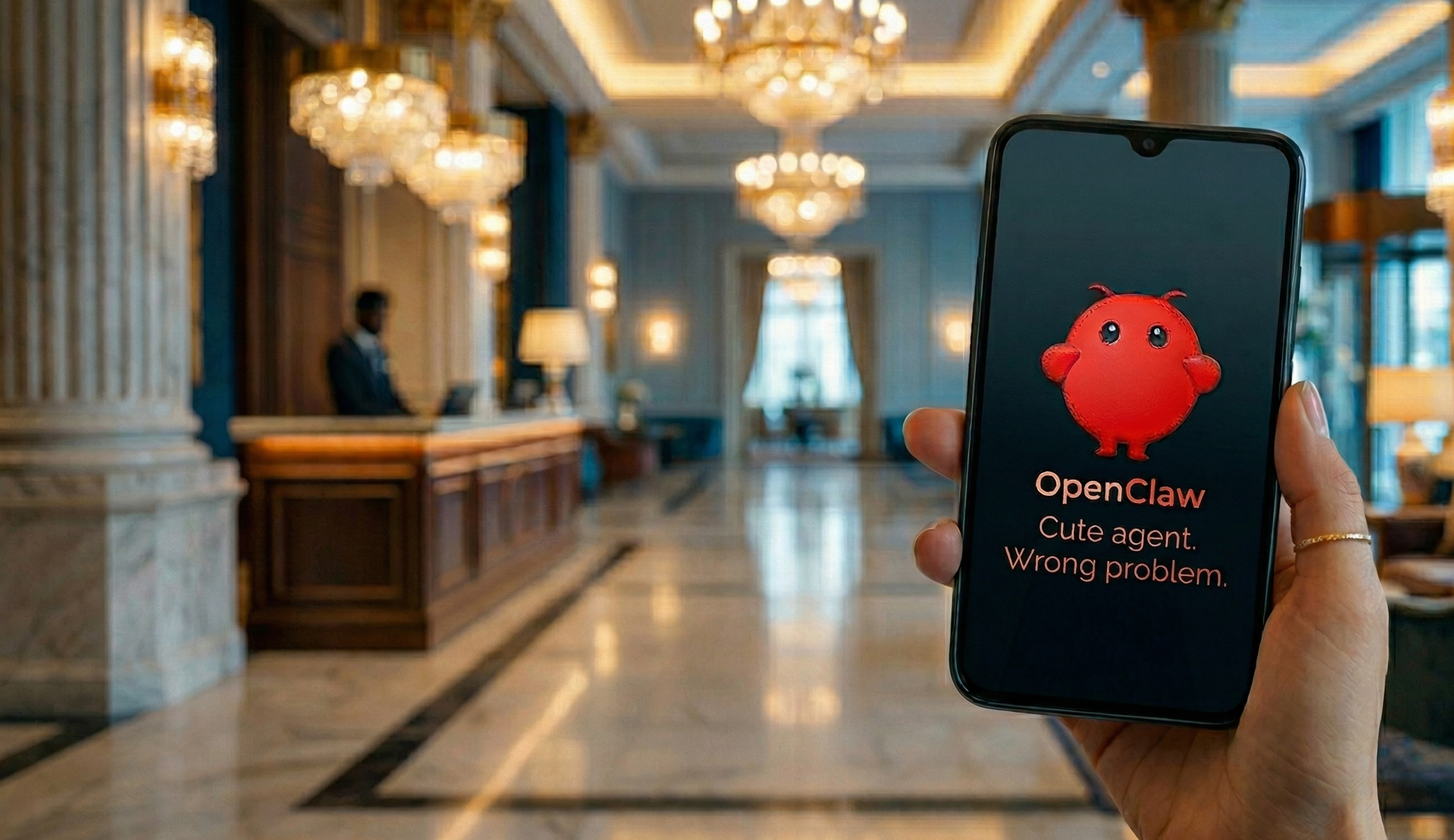
Agentic AI is reshaping hotel sales — the question is not whether, but where and how. (The image is AI-generated.)
What is Agentic AI — and why is it more than just a buzzword?
Agentic AI refers to AI systems that don't simply respond to individual inputs, but independently plan, execute and adapt multiple steps in sequence. While generative AI like ChatGPT produces content — drafts an email, writes a text — Agentic AI goes further: it writes the email, checks the calendar, compares availability, books a room and sends the confirmation. All within a single continuous workflow, without a human needing to step in after each stage.
The difference lies in the depth of autonomy: generative AI is a tool for producing content. Agentic AI is an actor that orchestrates processes across system boundaries. For hospitality, this matters precisely because cross-system coordination is what's missing in day-to-day operations — especially in sales.
OpenClaw: What's behind it — and where it falls short
OpenClaw is an open-source AI agent that runs locally on a computer and is controlled via chat apps like WhatsApp or Slack. It can sort emails, check calendars, manage files and execute scripts. Within a few months, the project has become a symbol of a new generation of AI systems that don't just answer — they act.
At the same time, OpenClaw as a concrete tool has significant security problems. Independent security researchers have identified a vulnerability that, under certain conditions, allows unauthorised remote access to the host machine — rated "highly critical" on the international scale for IT security vulnerabilities. Multiple analyses also show that a double-digit percentage of available extensions may contain malicious commands or malware. In China, government agencies and banks have been explicitly warned against installing it on company devices.
The key question, therefore, is not whether Agentic AI will become relevant for hotels — it will. The question is which areas generic agents can cover and where the complexity demands specialised systems.
“OpenClaw solves a different problem from ours. It automates what happens on a single machine — emails, calendars, files. That’s Agentic Computing. In Group & Convention Sales, the challenge isn’t desktop automation — it’s orchestrating MICE logic, revenue rules and proposal processes across multiple platforms. That requires specialised Agentic AI, and it’s becoming a baseline requirement, not a nice-to-have.” — Bernd Fritzges, CEO and Founder, MICE DESK
Transient vs. MICE: Why generic AI hits its limits in Group & Convention Sales
In the transient segment, AI agents can already perform reasonably well. A transient booking follows a clear pattern: room type, dates, standard rate, a handful of add-ons. The parameters are limited, the decision logic is standardisable. Availability checks, rate suggestions and booking confirmations can be automated with manageable effort.
MICE inquiries are the opposite. MICE stands for Meetings, Incentives, Conferences and Events — the segment covering group and event bookings in hospitality. Every inquiry is unique: individual room layouts, complex F&B packages, technical requirements, tailored cancellation terms, client-specific conditions, multiple alternative dates and often several delegate categories. A typical free-text inquiry with 14 line items and three alternative dates is simply not processable by a generic AI agent that can sort emails.
Add to this the dependency on revenue management strategies, inventory control and internal pricing logic. A purely text-based agent cannot handle this complexity without deep integration into the hotel’s system landscape. The operational lever lies not in generic all-rounders, but in specialised systems that understand MICE logic, revenue rules and hospitality workflows — and that can automate hotel proposal creation.
How can hotels automate conference and meeting inquiries?
Conference and meeting inquiries cannot be fully automated at the push of a button. What can be automated are discrete steps — extracting inquiry content, running availability checks, and generating proposal templates — with a human as the final decision-maker.
Meeting and conference inquiries cannot yet be fully automated at the push of a button — they are too individual, and too dependent on negotiation. What can be automated right now are the time-consuming steps in between: automatically extracting and structuring inquiry content, consolidating data from multiple systems, running automated availability checks, and generating standardised proposal templates. The final step stays with a human — a Human-in-the-Loop approach that combines speed with quality.
Critically, every hotel is on its own path towards greater automation. Full automation is not a short-term goal — but the incremental enrichment of internal systems with proprietary data is. That’s what allows AI-powered proposal automation in hospitality to be built up over time. Only hotels that systematically capture inquiries, proposals, rejections and conversion rates can meaningfully train AI systems and increase their level of automation.
The blind spots: Why data strategy comes before AI strategy
Hotels invest in PMS, CRM and revenue management — but these systems typically operate in isolation. If AI agents are to autonomously manage processes in the future, they need a coherent data model. This is precisely the structural problem that most hotels have not yet addressed.
“MICE sales is a structured sales process. The foundation would be a data-driven funnel analysis — the kind we know from other industries. But that requires all systems to be connected, so that total demand and supply can be mapped. The fact that rejected inquiries often aren’t captured at all shows where the problems start. Hotels aren’t even collecting all the data — and that’s step one of any data strategy.” — Tigran Manvelyan, CTO and Co-Founder, MICE DESK
The conclusion is clear: before hotels think about AI agents, they need to get their data landscape in order. If you’re not even capturing which inquiries are rejected — and why — you can’t measure conversion rates, identify revenue potential, or teach an AI system to make better decisions
What hotels should do now — five concrete steps
The good news: hotels don’t need to wait for the next technological breakthrough. The foundations for an agentic future can be built today — in five concrete steps.
1. clean up your data landscape. Semantic structuring of content — structured data on room categories, conference spaces, F&B packages, cancellation terms. Availability, pricing and proposals need to be available in machine-readable form.
2. break down system silos. PMS, Sales & Catering system, CRM, revenue management and event management need to be connected via stable interfaces. AI systems require access to a consistent data model — not fragmented individual systems.
3. build AI capability within the team. Not eventually — but as an operational priority now. Staff training, internal workshops, pilot projects using AI assistants for standard inquiries. Including clear guidelines on where AI decides and where the human has the final word. The myths about automation that get in the way are worth reading alongside this.
4. measure operational relief — OPEX and productivity as benchmarks. Automation in Group & Convention Sales must be measured against operational KPIs: how many working hours per week does the team recover? How much do process costs per proposal fall? Where does manual repetition become a scalable workflow? When evaluating specialised systems that understand MICE logic, revenue management rules and hospitality workflows, this is exactly where to start — the question of how much operational capacity is freed up that is currently tied up in repetitive tasks. Specialised systems for Convention Sales Automation make that relief measurable.
5. quantify commercial uplift — make revenue impact visible. Operational relief alone is not enough — automation must also work on the revenue side. Faster proposal turnaround increases conversion rates, because inquiries are answered while interest is still high. Structured data enables better revenue management decisions, because displacement effects become visible earlier. And a clean funnel shows where revenue is being left on the table — in inquiries answered too late, incorrectly prioritised, or never followed up. The commercial lever is often larger than the cost saving — but only measurable when the data foundation is solid.
The next step
Group & Convention Sales automation doesn’t start with AI — it starts with clean data, connected systems and processes built for speed. Rocket AI brings these foundations together into a platform that structures and accelerates MICE sales from inquiry to proposal.
If you want to know what that looks like for your hotel: book a demo and see where the biggest levers are in your proposal process.
Frequently Asked Questions (FAQ)
What is Agentic AI?
Agentic AI refers to AI systems that independently plan, execute and adapt multi-step processes. Unlike generative AI (e.g. ChatGPT), which responds to individual inputs, Agentic AI orchestrates complete workflows across system boundaries — from calendar checks to proposal creation to dispatch.
How can hotels automate conference and meeting inquiries?
Conference inquiries cannot be fully automated — they are too individual. But discrete steps can be: extracting inquiry content, running availability checks and generating standardised proposal templates. The final step stays with a human — a Human-in-the-Loop approach.
What is the difference between a chatbot and an AI agent?
A chatbot answers individual questions reactively. An AI agent independently plans multiple steps, interacts with different systems and executes complex tasks autonomously. In hotel sales: a chatbot answers an availability question. An AI agent checks availability, creates a proposal, aligns it with revenue management and sends it.
Is OpenClaw suitable for hotels?
OpenClaw works as a generic automation tool for simple, standardised tasks. For the complexity of Group & Convention Sales — with individual room layouts, F&B packages and revenue management integration — specialised MICE systems are required. There are also currently documented security vulnerabilities in OpenClaw.
Key Takeaways:
Agentic AI is the next evolutionary step beyond generative AI — from creating content to managing processes.
OpenClaw demonstrates the principle and the market is moving — for standardised tasks, Agentic Computing is viable. In Group & Convention Sales, specialised systems are required.
In the transient segment, AI automation already works — in MICE, AI-assisted Convention Sales requires purpose-built systems.
Before deploying AI agents, hotels need coherent data: rejected inquiries, funnel analysis, connected systems.
Automation must be measured on two axes: operational relief (OPEX, productivity) and commercial uplift (conversion, revenue, displacement).