 DE
DE

Hotel Proposal Automation: Why Static Documents Are Costing You Group Sales Conversions
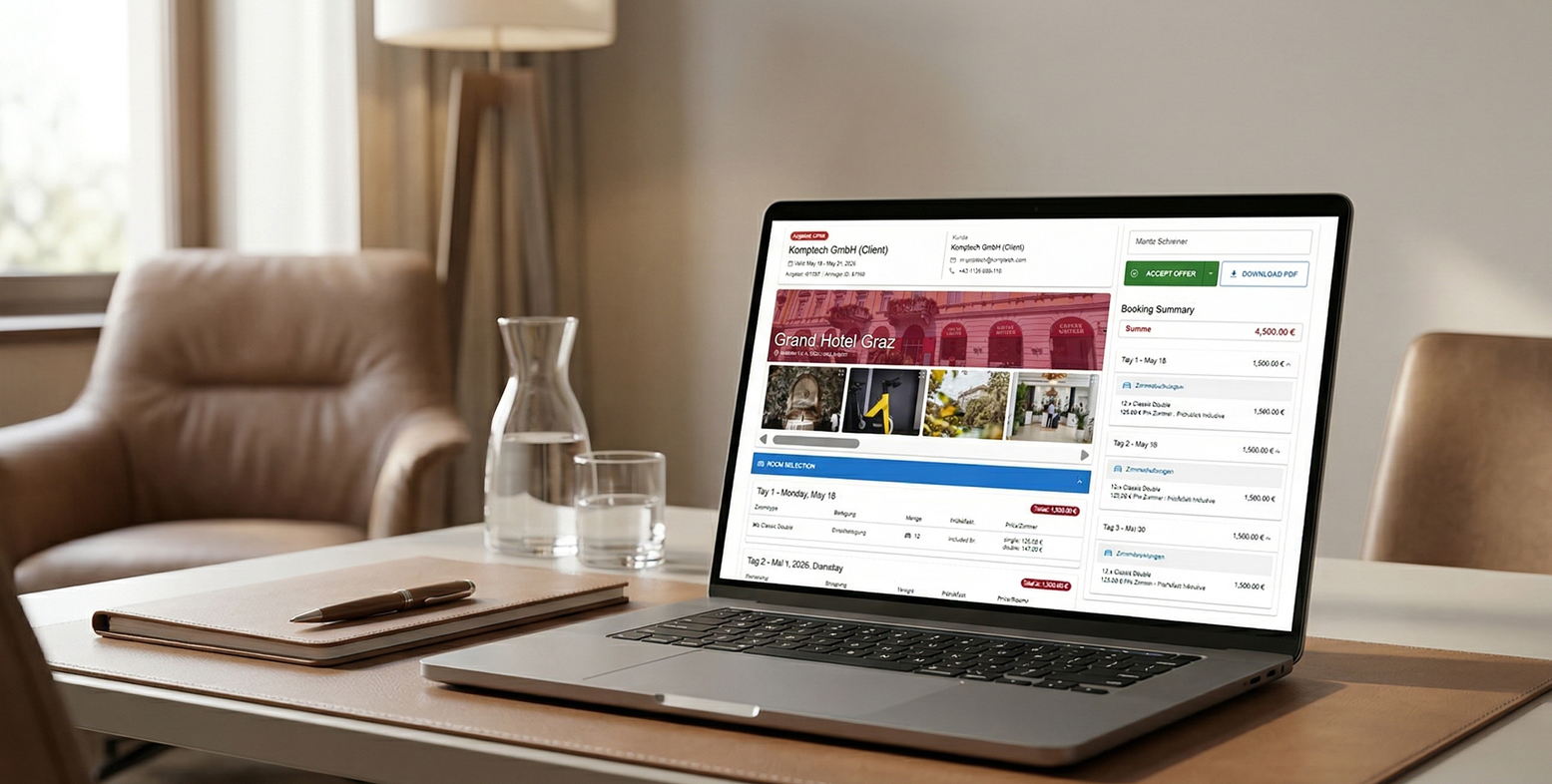
From a PMS document to an interactive proposal: How hotels can boost their MICE conversion rates. (The image is AI-generated.)
Hotels that automate their proposal process convert more group business – because digital proposals deliver behavioral data, eliminate media breaks, and accelerate decision-making. Gartner and McKinsey research confirms that customer experience now outweighs product and price in 70–80% of B2B buying decisions. Yet in MICE sales (Meetings, Incentives, Conferences, Events), the customer journey still frequently dead-ends at a generic PMS-generated document – with no tracking, no interactivity, and no feedback loop. Sascha Dalig, Commercial Director at Signo Hospitality, explains why static proposal documents systematically prevent bookings – and how hotel proposal automation measurably improves conversion rates.

About the author
Sascha Dalig, Commercial Director at Signo Hospitality:
Sascha Dalig is responsible for the entire commercial function at Signo Hospitality – spanning sales, revenue management, marketing, and communications. With more than 25 years of hospitality experience in operational and strategic leadership roles, he brings deep market understanding, franchise and brand expertise, and a strong focus on digitalization and sales strategy. As a speaker and moderator, he positions Signo Hospitality as a forward-thinking player in technology, people development, and sustainability.
What Hotels Can’t See: Decision Signals That Static Proposals Swallow
Digital proposal processes reveal what static PMS documents fundamentally cannot deliver: behavioral data. In modern B2B sales organizations, it is standard practice to measure whether a proposal has been opened, which sections are read, and how intensively decision-makers engage with specific options. In group sales and event management, these signals are almost entirely absent.
“Responses to traditional documents are limited to direct inquiries or confirmations. With a digital document, I can measure dwell time and run A/B tests to see which proposal format converts better.”
– Sascha Dalig, Commercial Director, Signo Hospitality
B2B buyers today use a wide range of interaction channels throughout the purchasing process. A proposal sitting as a static document in an email generates none of these signals – the hotel sees only the outcome (booking or rejection), never the journey.
These process signals are exactly what make the difference in data-driven sales organizations: Which modules get the most attention? Who in the buying center engages? Are there repeated views just before a deadline? Without digital proposal processes, pipeline assessment remains subjective.
The Media Break: Why PMS-Generated Proposals Disrupt the Customer Journey
The media break between digital research and a static proposal document is the single biggest structural barrier in the group sales process. What does a digital proposal process actually mean for a hotel? It means eliminating the disconnect that occurs when a planner researches online, submits an inquiry by email, and then receives a multi-page, PMS-generated Word-merge document in return.
“Traditional proposals are fundamentally disconnected – they represent a media break. Search on the web, inquiry by email, proposal by email, booking by email and phone. These proposals run to 14 pages, and a clear, simple message with all the information relevant to the buyer is missing at first glance.”
– Sascha Dalig, Commercial Director, Signo Hospitality
Hotels that invest in hotel proposal automation solve exactly this problem: the proposal becomes a living, modular touchpoint within the customer journey – personalized, tailored to the specific inquiry, and digitally seamless. As a group sales software platform, MICE DESK Rocket orchestrates the entire process from inquiry to interactive proposal.
What Meeting Planners Actually Expect – and Why Downloads No Longer Cut It
Professional meeting planners expect tailored proposals they can evaluate at a glance and share internally without friction. What was long considered standard – a PMS-generated document listing every conceivable option – is increasingly perceived as an obstacle in the decision process.
“Professional buyers expect proposals tailored to their needs. The standard meeting for up to 10 people with drinks and snacks in the room shouldn’t require three rounds of back-and-forth – it should be bookable directly and reliably. These small meetings make up the majority of MICE volume.”
– Sascha Dalig, Commercial Director, Signo Hospitality
Industry research consistently shows that meeting planners cite three core frustrations in the RFP process: unclear or incomplete responses, inaccurate pricing, and slow response times. Planners want to assess at a glance whether a venue fits their event, then quickly dive into the relevant details. Effective meeting management software addresses these pain points by delivering proposals that are structured for speed, not comprehensiveness.
What Is the Difference Between a Hotel Proposal Generator and a Word Template?
A hotel proposal generator creates digital, interactive proposals with tracking, personalization, and variant options. Word templates or PMS Word-merge documents produce static files without usage data, feedback channels, or the ability to run A/B optimization. Proposal evaluation is rarely a single-person decision – multiple internal stakeholders need to be involved. What’s needed are formats that allow easy sharing, commenting, and variant comparison – capabilities that a static download simply doesn’t offer.
No Usage Data, No Sales Strategy: The Cost of Flying Blind
Without behavioral data from digital proposals, hotels manage their group sales pipeline on gut feeling alone. What happens to a hotel’s sales strategy when there is zero visibility into whether and how clients engage with a proposal?
“Without knowledge of how proposals are used, a hotel’s sales team relies on instinct. The feeling of whether a proposal is good or bad, whether it stands out against the competition, whether something is missing for the client. The result: generic documents that aren’t tailored to the customer and often still contain checkbox fields.”
– Sascha Dalig, Commercial Director, Signo Hospitality
In a data-driven approach, hotels would actively prioritize highly engaged but undecided leads while automatically nurturing cold ones. Instead, follow-ups are prioritized by gut feeling. Leading indicators like open rates, repeat visits, and engagement with specific proposal modules – standard in other B2B industries – are completely absent.
How Do You Prioritize Group Inquiries Effectively?
The most effective prioritization is based on usage data from digital proposals: hotels can see which inquiries are being actively reviewed, which stakeholders are engaged, and where engagement patterns indicate high booking probability. Effective group inquiry management means steering your pipeline with objective behavioral data rather than self-reported CRM stages.
The Blind Spot: Why Rejection Rates Are Rarely Linked to Proposal Format
The proposal format itself is a critical but systematically underestimated factor in MICE rejection rates. Rejection rates in group sales are high – and almost exclusively attributed to price, availability, or competition. The idea that the format itself makes a difference is rarely investigated systematically.
“The rejection rate is a metric that doesn’t get examined deeply enough. A rejection is accepted, sales follows up once more, but whether the proposal itself was the deal-breaker is never questioned. Are proposals tailored to the inquiry, or just generic Word documents filled in via text fields?”
– Sascha Dalig, Commercial Director, Signo Hospitality
In the context of MICE sales, this means: unstructured, text-heavy, or hard-to-navigate proposals act as a switching signal – even when pricing is competitive. Research shows that more than half of B2B buyers will switch providers when the digital experience falls short of expectations.
Dalig’s recommendation is pragmatic: a controlled A/B test with comparable inquiries – identical content, one as a traditional document, one as an interactive digital proposal. The conversion rates speak for themselves.
“An A/B test on comparable proposals. That way a hotel can clearly see how many confirmations each format generates, and then make an informed decision about which proposal converts better.”
– Sascha Dalig, Commercial Director, Signo Hospitality
Want to see whether a digital proposal process improves your conversion? MICE DESK shows you in a personal demo how Rocket automates your hotel’s proposal workflow.
Streamlining the Hotel Proposal Process: Where Modernization Really Gets Stuck
The biggest barriers to modernizing the hotel proposal process lie in culture, competencies, and missing integrations – not in missing technology. Studies on digital transformation in hospitality consistently confirm this finding.
“I’m convinced that teams are not opposed to change. The question is how change is introduced. If change is imposed, resistance follows quickly. If the team is part of the process and sees benefits for themselves at the end, they become the biggest supporters.”
– Sascha Dalig, Commercial Director, Signo Hospitality
At the same time, Dalig identifies an often-underestimated technical barrier: missing integrations. Many hotels operate with closed systems – understandable for data privacy reasons, but a real obstacle to optimizing the proposal process. Access is denied, APIs are unavailable, data stays siloed.
How RPA and AI Automate Hotel Proposals – Even Without Open Integrations
MICE DESK addresses this challenge with an RPA approach (Robotic Process Automation): where integrations are missing or locked down, software robots handle data transfer between the PMS, CRM, and the proposal platform. This eliminates dependency on open APIs – hotels can implement a digital proposal process even in closed system environments. In the area of convention sales automation, the approach goes further: intelligent templates detect inquiry patterns and suggest matching proposal modules before a team member needs to configure anything manually.
Additional success factors lie at the organizational level: clear accountability, new ways of working, and systematic capability building. Faster RFP response automation rarely fails because tools don’t exist – it fails because processes, KPIs, and roles aren’t aligned with a data-driven proposal workflow.
Speed as Decision Factor: What Drives Meeting Planners Beyond Price
Speed beats price: meeting planners award the business to the hotel that delivers a relevant, clear proposal fastest. What factors truly influence how meeting planners make decisions – beyond price and availability?
“Speed. If a planner gets a suitable proposal quickly, the decision can be made quickly. Every follow-up question delays the process.”
– Sascha Dalig, Commercial Director, Signo Hospitality
Industry reports confirm: late, unclear, or incomplete proposals are often discarded even when pricing is attractive. Meeting planners evaluate multiple venues under intense time pressure. A provider whose proposals are easy to find, compare, and share internally gains a massive advantage – regardless of the final price point.
How Can Hotels Automate Their Proposal Process?
By deploying event management software like MICE DESK Rocket that transforms static PMS documents into interactive, trackable online proposals. The process includes automated data transfer (via RPA where integrations are unavailable), modular proposal building, and real-time usage analytics. Hotels that automate their proposal process don’t win on the lowest price – they win on the best experience.
How Do I Streamline My Workflow Using Hotel Proposal Management Software?
The most effective way to streamline your group sales workflow is to replace manual, step-by-step proposal handling with an automated system that manages the full process from inquiry to offer in one place. Hotel proposal management software like MICE DESK Rocket connects directly to your PMS and Sales & Catering system, pulls live availability and rates, and generates fully structured, interactive proposals in a fraction of the time it takes manually. Instead of switching between systems, chasing data, and formatting documents from scratch, your team focuses on personalizing and sending - not building from zero. Combine that with RPA-based data transfer for closed system environments, and the result is faster response times, fewer errors, and consistent proposal quality that measurably improves conversion across every inquiry channel.
How to Measure Proposal Format Performance with Data
Four baseline KPIs make proposal format performance measurable: conversion rate, response time, lead time, and rejection rate. Only when these are combined with engagement indicators can you reliably determine which format actually outperforms.
“Proposal conversion rate, time between inquiry and proposal delivery, lead time between inquiry and arrival date, rejection rate.”
– Sascha Dalig, Commercial Director, Signo Hospitality
These baseline KPIs can be supplemented with engagement indicators: proposal view rate (how many proposals are actually opened), dwell time and scroll depth per section, interaction rate with options and variants, and the number of stakeholders involved. Only when these data points are consistently analyzed by format, segment, and buying center structure can you truly streamline the hotel proposal process.
How Convention Sales Automation Transforms the Proposal Process
MICE DESK turns the black hole between proposal delivery and client feedback into a measurable, steerable process. Instead of static PMS-generated documents, hotels use the Rocket proposal module to create interactive, digital proposals – modular formats that show exactly what’s relevant to each specific inquiry. The platform automatically captures usage data: which modules are read, how long decision-makers spend on options, and when the proposal is forwarded to additional stakeholders.
“For us at MICE DESK, it was clear from day one that the entire process from inquiry to interactive proposal has to be seamless. This not only optimizes and relieves the operational teams in the hotel, but also delivers a first-class customer experience.”
– Bernd Fritzges, CEO and Founder, MICE DESK
For sales teams, this means: follow-ups are prioritized by data, not gut feeling. The automated hotel event proposal workflow is accelerated by intelligent templates and automated data transfer – via RPA if open integrations aren’t available. And ongoing optimization is based on real usage patterns, not assumptions.
Next Steps
If you want to see how a digital proposal process can work in your hotel or hotel group – with measurable results instead of generic documents – book a personal demo with our team. We’ll show you in 30 minutes how Rocket automates your proposal process, makes usage data visible, and lifts your conversion rate.
Key Takeaways
Static PMS-generated proposals produce zero behavioral data – hotels manage their group sales pipeline blind.
The media break between digital research and a static Word-merge document measurably costs bookings – customer experience outweighs price in B2B.
Meeting planners decide under time pressure: speed and clarity beat the lowest price.
A/B tests between traditional and digital proposal formats deliver proof – yet they are rarely conducted in hospitality.
MICE DESK’s RPA approach removes the integration barrier: digital proposal processes work even in closed system environments.
Further Reading:
Process Errors in Banqueting Operations: How Hotels Can Identify and Systematically Avoid Them
How hotels make ROI in the MICE sector measurable and profitable