 DE
DE

Hotel Group Sales Profitability: Why Full Event Spaces Don’t Mean Higher Margins

Definition: MICE Profitability
MICE profitability – where MICE stands for Meetings, Incentives, Conferences, and Events – describes the contribution margin that events generate per square metre and time unit, after variable costs, labour, and opportunity costs have been accounted for. It is the central steering metric in hotel group sales that classical occupancy KPIs like RevPAR or occupied room days simply cannot deliver.
A fully booked event calendar does not necessarily translate into strong event space profitability. Banquet halls in permanent use, a convention sales team hitting its targets – and yet the bottom line keeps falling short of expectations. This scenario is more common across European hotels than it might appear at first glance. The cause is rarely pricing alone. It runs deeper: into how hotels value, manage, and sell their event spaces.
Birgit Haake, Revenue Management expert and founder of Revenue4U, has encountered this pattern throughout more than 25 years of consulting practice. For this article, she has answered the central questions around MICE profitability from her perspective – complemented by current findings from industry literature and the day-to-day reality of hotels that systematically manage their Group Sales by contribution margin.
When hotels begin using modern Event Management Software to connect revenue data with the sales process, the same pattern emerges: the problem was never the tool. It was the absence of structured decision logic before the offer was even sent.

About our interview partner and co-author of this article:
Birgit Haake is an experienced Revenue Management expert and founder of the consultancy Revenue4U, with over 25 years of hands-on experience in hospitality and healthcare. As a former senior executive at Maritim Hotelgesellschaft, university lecturer, and published author, she specialises in yield optimisation across MICE (Meetings, Incentives, Conferences, Exhibitions) and digital distribution.
Why Most Hotels Don’t Actually Know Their True MICE Profitability
According to Birgit Haake the structural starting point for most MICE profitability problems is historical. Event spaces were – and still are – planned as a proportional share of total gross floor area per room, embedded within total investment costs. The logical consequence: in many hotels’ revenue strategies, event spaces are treated as a supporting element of room sales rather than as an independent revenue resource.
“Event capacities are often seen as nothing more than a by-product in the revenue strategy for selling hotel rooms. Compounding this is the absence of cost allocation for set-up, conversion, and staffing, and an inadequate data integration between Sales, Operations, F&B, and Revenue Management.”
– Birgit Haake, Revenue4U
Industry organisations such as HSMAI confirm this diagnosis: many properties manage their MICE business primarily by revenue – daily delegate rates, room revenue – rather than by contribution margin or GOP. Pure revenue metrics systematically overestimate actual profitability, because they ignore variable costs, labour, and margin differences across departments. There is also a technical problem: revenue data from room hire, F&B, technical services, and accommodation is typically fragmented across PMS, Sales & Catering systems, and accounting – and is rarely consolidated into a single view.
What Is MICE Revenue Management?
Haake recommends a MICE Revenue Management that applies the steering logic of room revenue management to event spaces and group business. Rather than maximising occupancy, capacity decisions are made according to the expected contribution margin per floor area unit and time block – accounting for demand, alternative business, and displacement costs.
The core elements are:
Space-based KPIs rather than room-level revenue figures: RevPASM and GOPPASM instead of RevPAR
Displacement analysis: Is the enquiry in hand worth more than the business it displaces? [LINK: /blog/profitability/displacement-analysis-hotel]
Dynamic pricing logic instead of static historical delegate rates
Demand-based capacity management instead of first-come, first-served
MICE Revenue Management is therefore the foundation for any form of Group Sales Automation that aims to go beyond simple process acceleration. It is what allows Meeting Space Revenue and Event Space Revenue to be actively managed rather than left to chance.
Occupancy Is Not Profitability: Three Metrics That Make the Difference
In day-to-day operations, MICE occupancy is often equated with occupied spaces or filled time blocks. What is systematically overlooked: whether the occupancy was economically sound.
“If every room were occupied by just one person, the space would be formally fully utilised – but economically, that would not be a success.”
– Birgit Haake, Revenue4U
Haake defines that from a yield perspective, at least three metrics are needed to assess the commercial quality of any booking:
Delegate density: How many people are actually using the space?
Revenue per delegate: What does each guest generate in total revenue across all streams?
Revenue per square metre: How productively is the space being used per floor area unit?
These metrics correspond conceptually to what HSMAI defines as Revenue per Available Square Metre (RevPASM) – a KPI that systematically links occupancy with revenue, much like RevPAR does for rooms.
But even these indicators are insufficient on their own: an event can still perform poorly in P&L terms despite solid revenue figures, if high labour and set-up costs arise simultaneously, complex configurations are required, or valuable parallel capacity is blocked.
Profitable occupancy therefore does not mean maximum occupancy, but maximum economic productivity of the space – measured by contribution margin relative to floor area consumed, time committed, and operational complexity.
The Silent Killer: Profit Loss Begins at the Moment of Acceptance
Where does the greatest lever for improved MICE profitability actually lie? Many hotels look first at pricing. The reality is different.
“In many hotels, profit loss does not begin with price – it begins at the moment of acceptance. Event spaces are often allocated on a first-come, first-served basis. Behind this lies not a deliberate yielding strategy, but a lack of transparency around daily demand, lead times, and the expected value of later enquiries.”
– Birgit Haake, Revenue4U
The result: capacity is blocked early, without asking whether the same space could have been used far more profitably at a later stage. Higher-value alternative enquiries are displaced, operational complexity rises – and the property is occupied, but not well sold.
HSMAI identifies this as one of the most common causes of suboptimal space productivity: low-priced events block large, flexible rooms during peak periods, and “dark space” – unused or poorly segmented areas – creates direct revenue and profit loss, because no systematic optimisation logic is applied at space level. Incorrect pricing and overly rigid option and cut-off rules compound the problem further.
This is precisely the point where modern Group Sales Automation systems intervene: they integrate revenue management data directly into the enquiry decision – making the contribution margin of an incoming request visible before acceptance.
MICE DESK in Practice
“We see it every day in the field: hotels accept or decline enquiries without knowing the actual contribution margin. The decision is based on experience or a sense of availability – not on a validated calculation. That is why we are working with our clients to integrate contribution margin directly into the offer process.”
– Bernd Fritzges, Founder, MICE DESK
What Hotels Need to Evaluate Group Enquiries Profitably
For a group enquiry to become a sound business case, a hotel needs structured data across four categories, as defined by Birgit Haake:
Revenue data: Room hire, delegate packages, F&B revenue, technical services, ancillary income
Volume data: Number of delegates, rooms used, duration, set-up type including changeovers and turnaround times, accommodation volume
Cost data: Food cost, variable labour, operational costs per event format, commissions
Steering data: Daily demand per event space and delegate band, lead times including wash behaviour, segment values, opportunity costs of capacity commitment
Without combining all four categories, an enquiry is not a business case – it is intuition. The steering data makes the greatest difference: only a hotel that knows which enquiries arrive when, and with what revenue potential, can genuinely apply displacement analysis.
Revenue management guides recommend systematically comparing forecast data for expected transient demand and alternative group business against the contribution margin expectations of an incoming enquiry. This is precisely what modern Meeting Management Software solutions automate – making the full picture available to the revenue manager at a glance rather than scattered across systems.
Why Historical Delegate Packages Are Often Unprofitable
A particularly sensitive area in group business: the pricing of packages. Many hotels work with delegate rates that were calculated once and then carried forward for years – without any systematic review of whether the underlying cost structures still hold.
“A package price only makes sense if variable costs and the scope of services are accurately calculated. It becomes problematic when hotels carry forward historical package prices, fail to adjust for rising labour costs, or price different event profiles using the same package.”
– Birgit Haake, Revenue4U
Revenue management guides therefore recommend breaking group packages down into modular components and defining a standard margin for each element – similar to how F&B controlling applies menu costing principles. At the same time, flat rates should be made dynamic to reflect demand, day of week, seasonality, and displacement risk, rather than applying rigidly calculated margins across all periods.
Misaligned Incentives in Group Sales: When Revenue and Profitability Diverge
One of the structural weaknesses in group and MICE sales lies in the incentive model. When salespeople are measured and rewarded based on booked revenue or space occupancy, the systemic incentive to account for displacement effects, variable costs, and space productivity is absent.
Industry publications consistently highlight that the organisational separation of Revenue Management and Convention Sales creates regular conflicts of interest: while revenue managers are tasked with optimising capacity by value, sales teams are measured on filling availability – even if this displaces more profitable alternative business. The result: low-margin bookings are accepted because the system rewards volume.
Revenue management systems therefore advocate shared KPIs: contribution-margin-oriented targets, displacement-consistent minimum rates, and clear room-to-accommodation ratios for all teams involved.
KPIs for Managing MICE Profitability in Hotels
Which metric can genuinely support more profitable decisions on group enquiries in daily operations? Birgit Haake identifies two conceptually sound approaches:
ProPAST – Profit per Available Space Time: How profitable is available space during a given time window?
ProPOST – Profit per Occupied Space Time: What profit does occupied space generate per time unit?
Both indicators correspond conceptually to what international literature defines as GOP per Available Square Metre/Hour (GOPPASM) – an extension of GOPPAR logic applied at floor-area level. Metrics such as RevPASM help hotels to actively manage Meeting Space Revenue rather than report on it retrospectively. The decisive difference from pure revenue metrics: they integrate costs, time commitment, and capacity consumption into a single decision figure.
“The complexity of these indicators and the absence of consolidated data are, however, a genuine challenge when it comes to embedding them into the offer logic.”
– Birgit Haake, Revenue4U
This names the central problem precisely: the conceptual framework for profitability-driven MICE management exists. Its systemic integration into the operational sales process has yet to be realised in most properties.
While many hotels conceptually understand contribution-margin-driven event management, the practical challenge lies in integrating these calculations into the day-to-day enquiry workflow. This is where systems such as MICE DESK Rocket support revenue teams.
How MICE DESK Rocket Integrates Profitability Data into the Offer Process:
“In MICE DESK Rocket, price proposals for the group rate and cancellation conditions are generated directly on the basis of the hotel’s individual restrictions and SOPs – what we call the Hotel Specific Knowledge Base – combined with data transmitted from the Revenue Management System. The revenue manager sees the projected F&B revenues at a glance and can approve or adjust the proposals. Control stays with the person – but the decision basis is structured and complete.”
– Evelyn Ebner, Director Onboarding, MICE DESK
Framework: Five Steps Towards Greater MICE Profitability
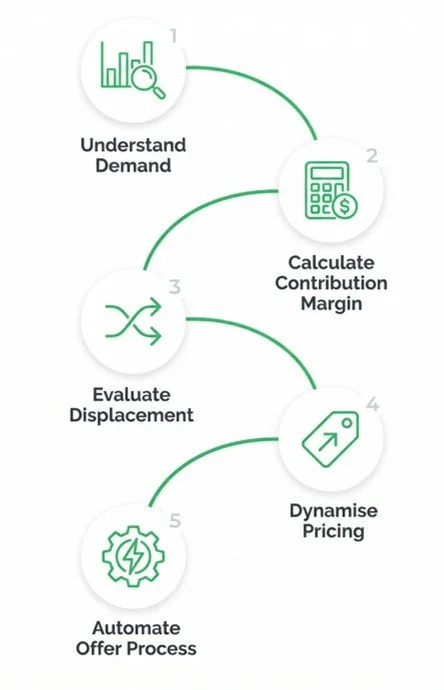
Five Steps Towards Greater MICE Profitability:
Understand demand
Which enquiries arrive when, with what lead-time profile and wash behaviour? Without historical demand analysis, every capacity decision remains reactive.
Calculate contribution margin
Translate revenues, variable costs, labour, and time commitment into a single figure – per floor area unit and time block, not per event overall.
Evaluate displacement
Is the enquiry in question worth more than the business it displaces? Only an explicit displacement calculation answers this question with any validity.
Dynamise pricing
Adjust delegate rates according to demand, day of week, seasonality, and displacement risk – not by carrying forward historical figures.
Automate the offer process
Group Sales Automation closes the gap between revenue management logic and the sales process: profitability data flows directly into the offer decision.
Rethinking the Model: Event Spaces as Independent Profit Centres
The paradigm shift that leading industry organisations have been advocating for years can be reduced to one central statement: event spaces must stop being treated as a service infrastructure for room sales. They are an independent, finite revenue resource – with their own management logic, their own KPIs, and their own contribution to the operating result.
“Sustainable profitability begins where hotels stop seeing event spaces merely as a sales object and start managing them as an independent profit centre. As long as event spaces are managed by availability rather than by value, profitability remains a matter of chance.”
– Birgit Haake, Revenue4U
What has long been standard practice in room sales – forecasting, demand assessment, dynamic pricing, capacity management by value – must be transferred to event spaces. Complemented by clear metrics for space productivity and contribution margin, simple occupancy becomes genuine results management.
At an organisational level, this means Revenue Management, Convention Sales, F&B, and Finance must share common objectives, KPIs, and decision logic – rather than optimising in silos. And incentive systems in group sales must be oriented towards contribution margin, not revenue volume.
FAQ: MICE Profitability and Group Sales in Hotels
What does MICE profitability mean in a hotel context?
MICE profitability describes the contribution margin that Meetings, Incentives, Conferences, and Events generate per occupied floor area and time unit – after deducting variable costs, labour, and opportunity costs of capacity commitment. It is the central steering criterion that pure occupancy metrics fail to deliver.
What is the difference between occupancy and profitable occupancy?
Occupancy measures whether space is in use. Profitable occupancy measures whether the contribution margin achieved per floor area unit and time block exceeds the opportunity value of committed capacity. A fully booked room can be either profitable or loss-making – what matters is not the occupancy itself, but the economic quality of that use.
Which KPIs do hotels use to manage MICE profitability?
The most important metrics are: RevPASM (Revenue per Available Square Metre), GOPPASM (Gross Operating Profit per Available Square Metre/Hour), and ProPAST/ProPOST (Profit per Available/Occupied Space Time). A practical starting point for daily operations is: expected contribution margin of the enquiry ÷ committed capacity (sqm × hours) – adjusted for the opportunity costs of displaced business.
How can hotels calculate the profitability of a group enquiry?
The starting point is a four-step calculation: (1) Total expected revenue across all streams – rooms, F&B, room hire, ancillaries. (2) Deduct all variable costs – food cost, labour, commissions. (3) Divide the resulting contribution margin by the floor area and time committed. (4) Compare this figure against the expected contribution margin of the business that would be displaced. If the enquiry clears the displacement threshold, it is economically sound. If it does not, negotiation or reallocation is the right response.
What is Group Sales Automation and how does it support profitability management?
Group Sales Automation refers to the use of hotel Group Sales Software and AI logic to process group enquiries in a structured, fast, and data-driven manner. It becomes profitability-relevant when automation solutions integrate revenue management data, hotel SOPs, and space productivity metrics directly into the offer process – so that pricing proposals are generated on the basis of validated calculations rather than experience alone. This is what distinguishes effective Meeting Management Platform solutions from tools that simply accelerate manual workflows.
Is there a minimum threshold below which a group enquiry is no longer economically justifiable?
There is no fixed universal threshold – it is always derived from the comparison: contribution margin of the enquiry minus variable costs minus opportunity value of the displaced alternative. During low-demand periods, the viable threshold may approach break-even. During peak periods, an enquiry should clearly exceed the expected transient revenue for the same period and the same space.
Key Takeaways:
Occupancy is not a reliable indicator of MICE profitability – contribution margin per floor area unit and time block is the metric that matters.
Profit loss most often occurs at the moment of acceptance, not at the pricing stage.
MICE Revenue Management transfers classical revenue logic – forecasting, displacement, dynamic pricing – consistently to event spaces.
Meeting Space Revenue and Event Space Revenue become manageable variables once spaces are treated as independent profit centres.
Group Sales Automation connects revenue data with the offer process and makes contribution margin the basis for decisions rather than an afterthought.
How Hotels Operationalise MICE Profitability:
With MICE DESK Rocket, hotels integrate revenue management logic directly into the group sales process:
Automated contribution margin calculation based on RMS data
Dynamic pricing proposals for group rates and cancellation conditions
Structured processing of group enquiries on a validated calculation basis
Human-in-the-loop approval: the revenue manager decides, Rocket provides the foundation
Sources & Further Reading:
HSMAI Americas: A Path to Meeting Space Utilization and Revenue | HSMAI: GOPPAR Definition | MyForecast RMS: Revenue Management Strategies for MICE | Haake Revenue4U Blog: Displacement Analysis in Revenue Management | HSMAI Academy: Maximising Event Space Revenue | Haake, Birgit; Zech, Nicola: Revenue Management im MICE (Erträge im Hotel und Eventmanagement optimieren). : UVK Verlag
Some images in this article come from Unsplash.