 DE
DE

Process Errors in Banqueting Operations: How Hotels Can Identify and Systematically Avoid Them

The MICE business (Meetings, Incentives, Conferences, Events) generates up to 40% of total revenue in many hotels. At the same time, it remains one of the least standardised and most error-prone areas of hotel operations.
Based on a two-year analysis of group and convention sales workflows, one insight stands out clearly: more than half of all errors occur long before the event takes place – during sales and the sales-to-operations handover.
Operations teams usually execute exactly what they receive. The real issue is that they often receive incorrect information, incomplete instructions, or no updates at all. In hospitality, process optimisation does not start with room setup or service delivery – it starts with the very first customer enquiry.
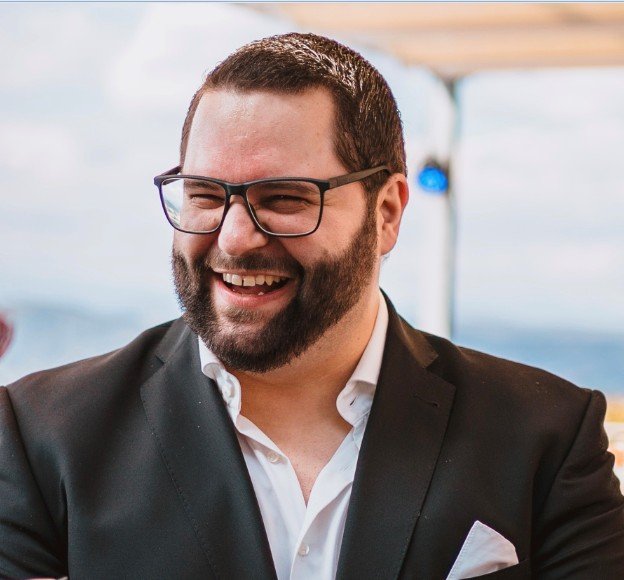
Lukas Ritzinger
Director of Groups & Events and Reservations at the Florian Weitzer Hotels & Restaurants, brings over ten years of experience working at this critical interface. His view is clear: most errors do not originate in service delivery, but in the initial customer interaction.
Needs Analysis: The Most Underestimated Source of Errors
Where do most process errors actually originate? According to Lukas Ritzinger, the answer is unambiguous:
“Most errors occur during the needs analysis immediately after an enquiry is received. What does the client really want? What matters most to them? What is critical for the booking decision? Asking the right questions is essential for creating a tailored proposal.”
In practice, this phase is massively underestimated. Hotels invest in systems, training programmes and process documentation – yet the first few minutes after an enquiry often determine the entire process. Errors made at this stage cascade through sales, operations and execution. Operations teams are then confronted with misaligned customer expectations without realising it.
Data from our research supports this assessment. Around 25% of errors already occur during the sales and proposal phase due to unclear or missing specifications. Another 20% arise during the handover, when function sheets (BEOs – Banquet Event Orders) are created too late, incompletely or not at all.
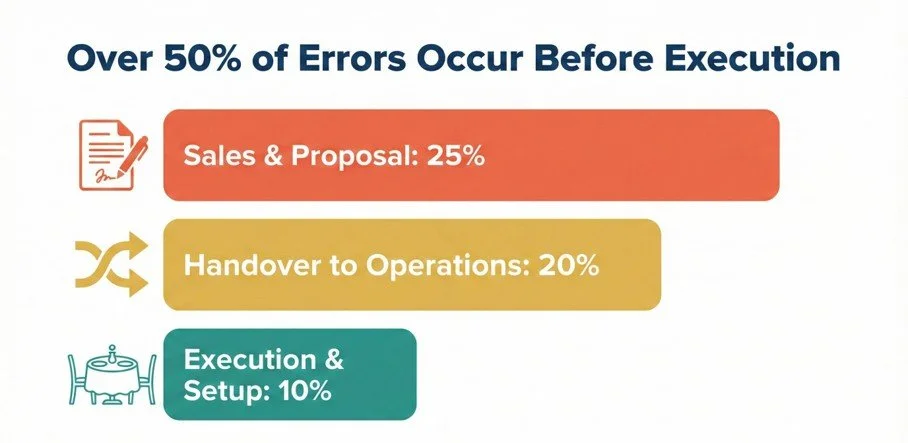
Over 50% of errors occur before executing an event. Most of them occur during the sales and proposal process.
The Most Expensive Mistake: Blocking Capacity Without Revenue
Which errors have the highest financial impact? Not minor event-day setup errors, but structural information gaps that build up over weeks.
Room blocks, schedules or attendee numbers are often unclear at the time of booking. This leads to constant changes right up to the cancellation deadline. As a result, capacity is blocked unnecessarily and expected revenue decreases.
This problem is widespread across the industry. Hotels frequently hold inventory for enquiries that later change significantly or fall through entirely. Industry benchmarks show that prime cost in banqueting should not exceed 50%. In reality, error-related inefficiencies often push this figure to 60–65% due to hidden costs: repeated coordination loops, last-minute room changes, or kitchen overproduction caused by outdated attendance figures.
Why Documentation Fails: Treating MICE as a Side Business
A core issue lies in the system landscape. Many hotels operate parallel, non-integrated systems: one for sales, one for operations, one for accounting. Function sheets still exist as Word documents, PDFs or handwritten notes. This fragmentation prevents a single source of truth.
Lukas Ritzinger identifies the root cause clearly:
“Systems and interfaces are poorly aligned. MICE is still treated as a side business in many hotels, which means its data does not receive the same relevance as pure room revenue figures.”
The consequence is manual data maintenance across multiple systems – a process that is time-consuming and highly error-prone. Changes are often not updated consistently. Reports are only partially customisable. Manual information transfer becomes one of the biggest risk factors, especially since last-minute changes are the norm, not the exception, in group and event sales.
How expensive that manual transfer is has since been measured. Across 24 hotels and 4,824 group RFPs, BEO creation consumed 39 minutes per case and manual data entry into the PMS and sales and catering system another 42. See the group sales process time study for the full phase breakdown.
A Hidden Risk: Loyal Clients Without Documented History
One of the most underestimated risks affects the hotel’s most valuable clients:
“Regular banqueting clients expect a higher service level than new customers. Without proper handovers and documented history in the PMS, service quality can deteriorate over time and become a major source of errors – especially when clients expect everything to be ‘as usual’.”
The paradox is clear: the longer the client relationship, the greater the risk if preferences are not documented. Clients assume the hotel knows them. When the responsible sales manager is absent or leaves the company, this implicit knowledge disappears. The result is disappointment among exactly those clients who generate the highest revenue.
What Defines a Mature Group and Event Sales Process
What does a truly mature process look like? For Lukas Ritzinger, the key indicator is time:
“A smooth, automated process gives employees the opportunity to spend far more time on consulting and upselling. Administrative tasks are reduced, and customer service takes centre stage.”
In an ideal workflow, customer data and enquiries are captured automatically and displayed in a central dashboard. Email communication and customer history are visible in one system. Proposals are created and sent within the same workflow. Deadlines and follow-ups are triggered automatically. Function sheets are structured so that operations teams immediately understand tasks and timelines.
Hotels that consistently implement this approach report measurable results: up to 90% fewer manual errors, 50% higher productivity in banqueting teams, and 20–25% higher profitability.
How Convention Sales Automation Reduces Process Errors
These challenges are not isolated incidents – they are structural weaknesses that can be addressed systematically with the right tools. With Rocket, MICE DESK has developed a solution that targets the most critical points: needs analysis, information flow and handover.
Bernd Fritzges, CEO and Co-Founder of MICE DESK, explains:
“The initial needs analysis is massively underestimated. Our two-year research on process times clearly showed that every minute saved during needs analysis costs ten times more later – or leads directly to errors in proposal creation. That’s why Rocket supports sales teams with automated needs analysis.”
Tigran Manvelyan, CTO and Co-Founder, adds:
“Communication history and incoming changes via email are processed automatically and assigned directly to the relevant project. This not only saves enormous amounts of time, but also eliminates process errors.”
Instead of manually transferring information between systems, data flows automatically from the first customer contact through to the function sheet (BEO). Changes are captured centrally and shared across all departments. Customer history is accessible to the entire team. The result: shorter response times, automated proposal creation and a seamless workflow without information silos.
The Next Step:
Process errors in banqueting operations are not inevitable. They are the result of systemic weaknesses in documentation, communication and system integration – and they can be fixed.
The first step is an honest assessment:
Where do most follow-up questions from operations arise?
Which information is lost repeatedly?
How much time does your team spend coordinating instead of advising clients?
Book a demo to discover how Rocket reduces process errors in banqueting and group sales.
Key Takeaways
More than half of all errors occur before execution
Sales and handover are the critical phases – not the event day.Manual information transfer is the biggest risk factor
Without a single source of truth, errors are unavoidable.Loyal clients are an underestimated risk
Expectations rise with relationship length – undocumented history leads to disappointment.Process maturity is measured in available time
If teams coordinate more than they advise, automation is missing.The investment pays off
Mature processes deliver 20–25% higher banqueting profitability and up to 90% fewer manual errors.
Author:
Lukas Ritzinger is Director of Groups & Events and Reservations at the Florian Weitzer Hotels & Restaurants in Graz, Austria. With over ten years of experience in hospitality and banqueting operations, he is responsible for the entire MICE business across the Weitzer Hotels portfolio, including the Hotel Weitzer, Grand Hôtel Wiesler and Hotel Daniel in Graz as well as the Grand Ferdinand und Hotel Daniel in Vienna.
His professional focus lies at the intersection of group sales, convention sales and operations. Lukas works closely with sales and operational teams to reduce process errors, improve internal handovers and increase profitability in meetings and events. His core belief: time spent on consulting and service quality is the strongest revenue driver in group and event sales.
The Weitzer Hotels use MICE DESK Rocket AI to optimise their convention sales workflows and reduce manual errors across the organisation.