 DE
DE

Half Arrive Too Late, Only 2% Ask: Conference Hotel Proposals in 2026
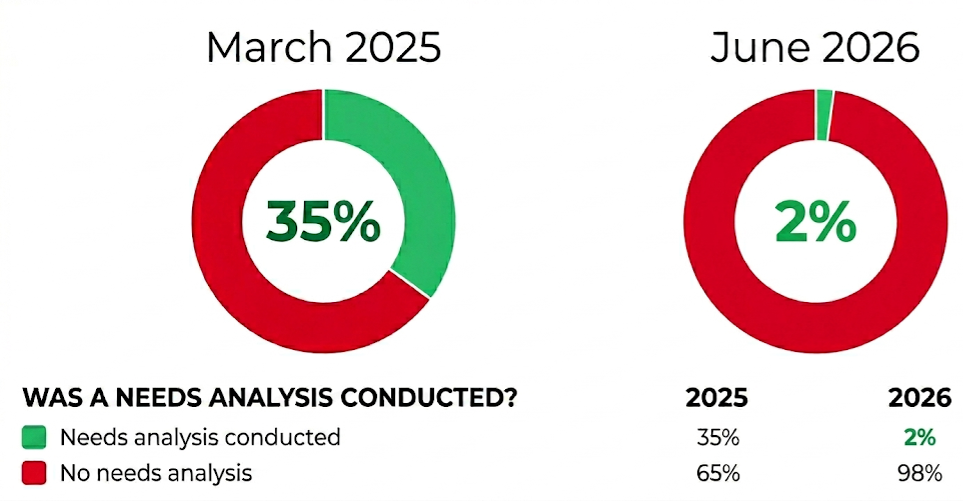
Needs analysis before quoting: 35% in March 2025, only 2% in June 2026.
More than half of all conference inquiries are answered only after more than 48 hours, and only 2% of hotels assess the client's needs beforehand. In the previous benchmark from March 2025 it was still 35%. Not a single proposal was both fast and needs-based. That is the finding of an analysis of 294 real inquiries sent to German conference hotels in June 2026.
What the survey measured
The data come from 294 real inquiries to German conference hotels, collected in June 2026. This was not a survey and not a set of simulated scenarios, but genuine inquiries whose handling was assessed across the entire communication. Four dimensions were measured: the response to the inquiry, the proposal turnaround time, whether a needs assessment was conducted, and advisory quality on a five-point scale.
The comparison basis is our previous benchmark report, published in March 2025. Some changes may also relate to seasonal inquiry volume and the requested event format. The pattern is nonetheless unambiguous.
A needs assessment is the structured clarification of an inquiry's actual requirements before a proposal is created. This includes attendee numbers, event format, seating, room requirements, and arrival and departure. It is the basis for a proposal that fits the inquiry instead of resting on assumptions.
Response to inquiries: more rejections, less substance
Hotels respond more often today, but the nature of that response has deteriorated. The share of properties that submit a proposal at all is practically stable at 47% versus 46%. What has shifted is what happens to the rest.
Active rejections by the hotel have more than doubled, from 11% to 28%. At the same time, the share of inquiries that receive no response at all has fallen from 36% to 26%. At first glance this looks like an improvement: fewer inquiries vanish into silence. In reality, only the ratio of silence to rejection has shifted. More response does not mean more quality, and a property that declines is as useless to an event planner as one that stays silent.
Needs assessment in free fall: from 35% to 2%
The central finding of the survey: only 2% of the hotels contacted asked about the client's needs at all before quoting. In the previous benchmark it was 35%, a good third of them even within the first twelve hours. Today, 98% of properties do not clarify the client's needs at all before sending a proposal.
This means proposals are created almost entirely on the basis of assumptions rather than actual needs. And not one of the 2% delivered the needs assessment within 24 hours. The substantive depth of inquiry handling has therefore collapsed almost completely, and that is the central weakness of the entire survey.
“Speed alone is not the problem. Speed without a needs assessment is.”
– Bernd Fritzges, Founder & CEO, MICE DESK
This framing hits the core, but it must not be mistaken for an all-clear on speed. Speed is itself the second problem, as the next section shows. Both axes are poor: most hotels are too slow, and almost none assess the need.
Proposal times: over half too late, no middle ground left
More than half of all inquiries are answered only after more than 48 hours (53%, previously 36%). For event planners deciding under time pressure, that is simply too late in most cases. This is the market's normal state, not the outlier.
On top of that, the middle has disappeared: the reliable 24-to-48-hour band has collapsed from 24% to 0%. The market now knows only two speeds, within the expected 24-hour industry standard or clearly too slow, and the slow camp is the larger one.
The fact that slightly more properties deliver within 24 hours at the top end carries little weight. As the previous section shows, these fast proposals are created almost without exception without any needs assessment. Speed without clarifying needs does not generate bookings, and the slow majority generates them even less.
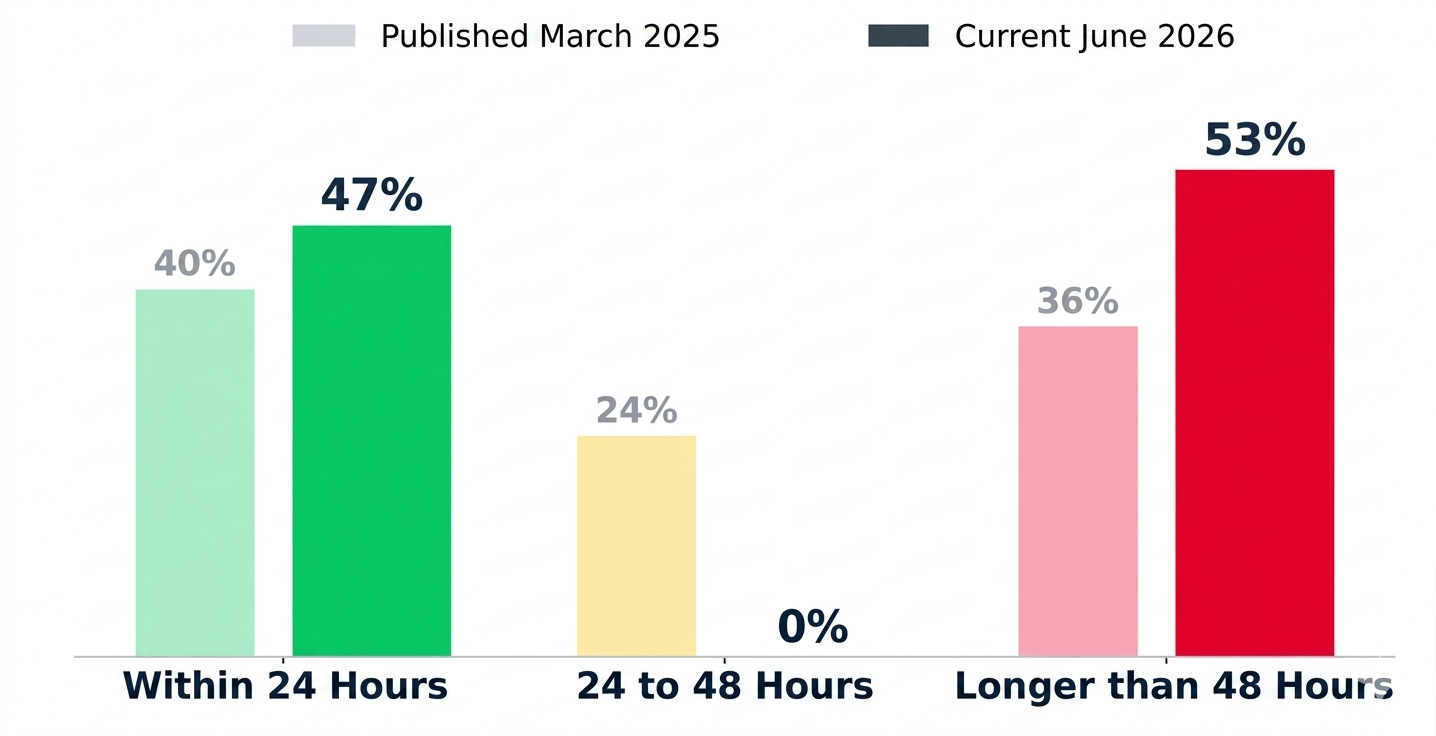
The reliable middle ground has vanished; the market splits into proposals within 24 hours and those that arrive clearly too late.
Advisory quality: from 20% to 4%
Beyond the mere completeness of a proposal, the survey assessed whether sales teams show genuine advisory competence: whether they ask about needs, raise follow-up questions, and respond to individual requirements, instead of sending a standard proposal with no relation to the specific inquiry.
The share of proposals with good to very good advisory quality has fallen from 20% to 4%, which across 294 inquiries amounts to roughly a dozen properties. The remaining 96% send a standard proposal without any follow-up question. In practice, basic information is then often missing: the seating arrangement goes unasked, pre-arrivals and service contents are assumed rather than clarified, and in some cases even room details are absent.
The survey's single sharpest figure captures both dimensions: in the previous benchmark, 8% of hotels still delivered a proposal that was both fast (under 24 hours) and needs-based. Today it is 0%. Not a single property met both criteria.
What this means for event planners
For event planners, this means the incoming proposal rests on assumptions in 98% of cases, not on the stated need. Anyone planning a complex event cannot rely on a standard proposal reflecting the actual requirements. A targeted follow-up question from the hotel is now the exception, not the rule, and it is a reliable signal that a property is taking the inquiry seriously.
In practical terms, planners should put as much of their requirements as possible into the initial inquiry, because the likelihood of the hotel asking on its own is low.
What this means for hotels
For hotels, this is the opportunity, and it is twofold: a property that leaves the slow majority and clarifies the need does not merely stand out a little, it meets a criterion that currently not a single property fulfils. After all, the share of proposals that were both fast and needs-based stands at 0%.
This is exactly the bottleneck: speed and needs orientation at the same time. It is the structural problem of many operational teams, lacking the capacity to qualify every inquiry quickly and properly. A separate MICE DESK study on conversion times – by far the most in-depth analysis of its kind, covering over 7,000 proposals – shows what is at stake: proposals that reach the client within three to five hours achieve up to 55% conversion. Speed pays off, then, but only combined with a proposal that fits the inquiry.
This is precisely the gap MICE DESK closes with Rocket: inquiries are captured and qualified in a structured way, so that a complete, needs-based proposal emerges without playing speed off against diligence. A human stays in the approval loop; the structure ensures no requirement is lost.
Frequently asked questions
How many hotels conduct a needs assessment before quoting?
According to the MICE DESK survey of June 2026 (294 real inquiries to German conference hotels), only 2% of hotels clarify the client's needs before quoting. In the previous benchmark of March 2025 it was 35%. Today, 98% of properties create their proposal without any prior needs clarification, on the basis of assumptions.
How long does a conference hotel proposal take on average?
Most conference proposals arrive too late: 53% reach the client only after more than 48 hours. Just under half come in under 24 hours, but almost always without a prior needs assessment. The reliable 24-to-48-hour band has collapsed to 0%. Speed and needs clarification are therefore missing at the same time.
Why doesn't a fast proposal alone lead to a booking?
Because speed without clarifying needs only sends assumptions quickly. A proposal that misses the actual requirements is not improved by arriving early. Only the combination of speed and a sound needs assessment reliably turns an inquiry into a booking.
How does a hotel stand out among conference inquiries?
By deliberately asking about the need before quoting. Since 98% of the market does not do this, even a short, consistent needs assessment is enough to stand out visibly. Targeted follow-up questions on seating, room requirements, and event format signal to the planner that the property takes the inquiry seriously.
The next step
Want to know where your property stands against these numbers? In a short demo we show how speed and needs orientation combine in proposal creation, without additional staff, and how more inquiries reliably turn into bookings.
Key Takeaways
Only 2% of conference hotels assess the need before quoting, down from 35% in the previous benchmark. Proposals are created almost entirely on assumptions.
Hotels respond more often, but not more competently: rejections rose from 11% to 28%, and advisory quality fell from 20% to 4%.
Over half of proposals (53%) arrive only after more than 48 hours, which is the norm. The 24-to-48-hour band has collapsed to 0%.
Not a single property delivered a proposal that was both fast and needs-based. This figure fell from 8% to 0%.
A short needs assessment now sets a property apart from 98% of the market and is the most effective lever for differentiation.