 DE

By Bernd Fritzges, Founder of MICE DESK
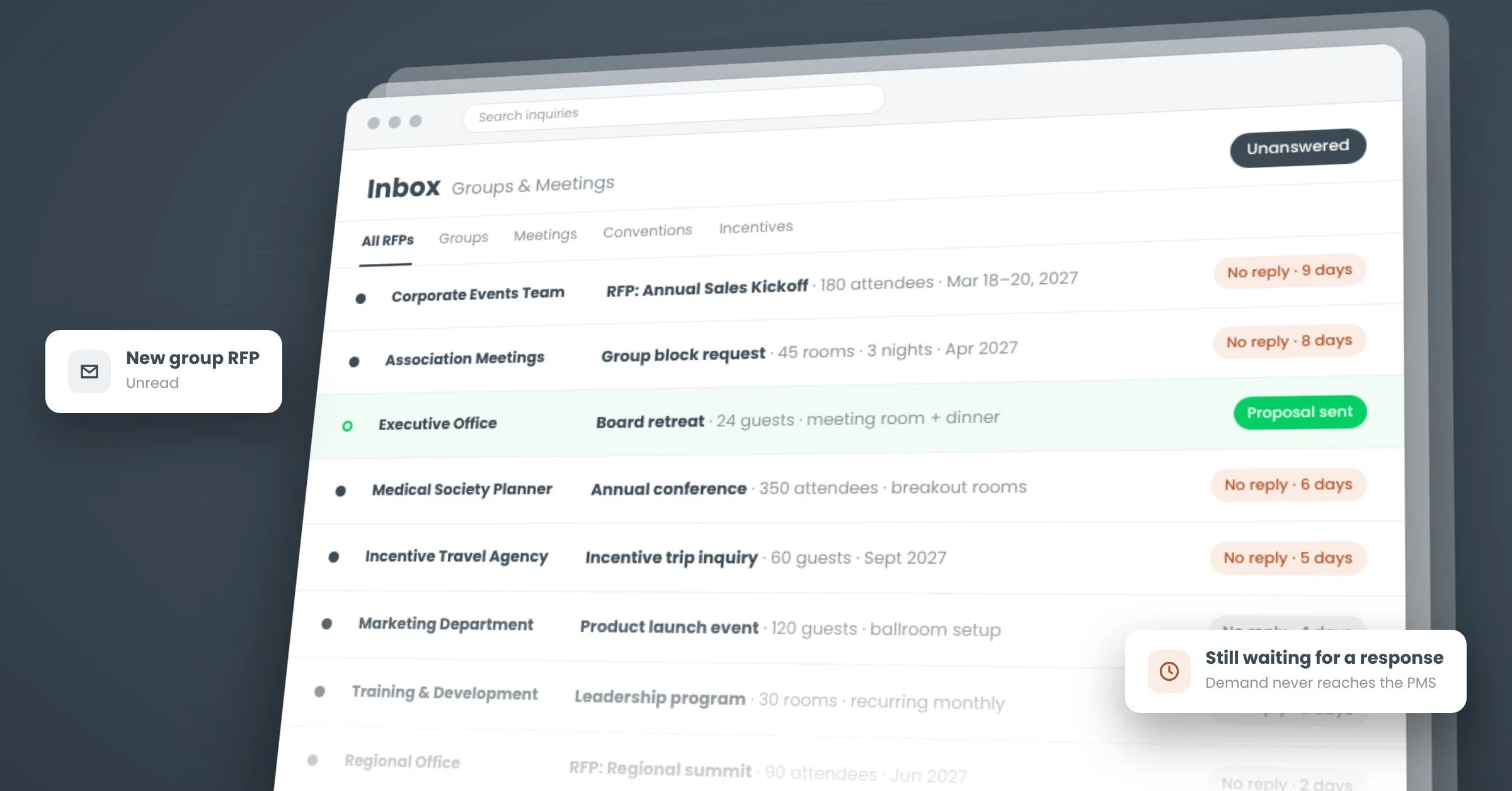
When a hotel does not answer a group, meeting or convention RFP, it loses the business. That part is obvious. The larger loss is invisible: the demand never enters any system. Revenue management then calculates prices on a base that is missing part of the market.
You lose more than one booking
An unanswered RFP costs a hotel three things:
The business itself goes to a competitor.
The demand is never captured in the property management system (PMS) or the sales and catering (S&C) system.
Every revenue decision built on that data is distorted.
What isn't answered doesn't exist in any system.
How many hotel RFPs go unanswered?
According to the MICE DESK Benchmark Report (June 2026, based on real inquiries), 26 percent of inquiries receive no answer at all.
A MICE DESK deep-dive analysis of one hotel operation found a second gap. 14 percent of proposals leave no trace in the PMS because they were offered without an option and never booked. The basis is the number of proposals. The two figures come from different studies and should not be added up.
Five ways an inquiry can end
An inquiry can end in five ways, and only the first one creates data.
Proposal with option, recorded in PMS and S&C
Offered without option, not booked
No answer
Declined by email
Alternative date or venue declined
Four out of five leave nothing behind. Two of them are measured. Declines and rejected alternatives are not quantified yet. The 26 percent is therefore the lower bound.
Why don't hotels respond to RFPs?
After more than 30 years in MICE (Meetings, Incentives, Conferences, Exhibitions), I don't see a single cause. It is all of these at once:
Staff shortages
Missing technology
Wrong priorities
Weak leadership
That is why there is no single fix.
How does an unanswered RFP distort revenue management?
Revenue management works on the demand it can see. If part of the demand never reaches the system, the calculation base is wrong. The logic built on top of it is wrong as well, and so are the prices. The model may be correct. Its input is not.
How can hotels make sure every RFP gets answered?
I would use technology and AI to make sure every incoming inquiry is captured, processed and prioritized. I would automate the process all the way to the proposal. People come in only after the proposal is created. That is where a human makes the difference and lifts conversion.
I know the other side of this from my own business. In 1995 I became an entrepreneur with a venue that seated up to 3,500 people indoors. Every inquiry and every proposal was handled on paper. We did not analyze anything with technology. Looking back, I often ask myself what today's tools would have been worth to us. We would have seen every inquiry, including the ones nobody answered. We would have known which dates were really in demand and could have priced them accordingly. The information was there in every request. We just had no way to capture it.
What results does a faster first response deliver?
Two hotel groups show what happens when every inquiry gets a fast answer. One cut its time to proposal from 7 days to 18.3 hours. The other grew group revenue by 50 percent.
Pestana Hotel Group: from 7 days to 18.3 hours
Before MICE DESK Rocket, our AI Revenue Operating System for hotel group and convention sales, the median time to proposal across 15 pilot hotels was 7 days. With Rocket, it is 18.3 hours today. The baseline compares PMS and email inboxes from the previous year for the same 15 hotels. The basis is answered inquiries.
Planners expect an answer within 24 to 48 hours. 18.3 hours is still too long, because the group rate is decided by hand. The revenue management step remains manual.
The target, agreed with Pestana in October 2026, is a median of 3 minutes across almost 100 hotels. 40 percent of proposals are to be fully automated by year end, with the rate calculated automatically. This is a target, not a result.
Florian Weitzer Hotels: 50 percent more group revenue
In the six months before Rocket, group revenue was €2.58 million. In the first six months with Rocket, it was €3.88 million, an increase of 50 percent. The comparison covers the same five hotels and the same team, based on 5,211 blocks.
Lukas Ritzinger, Director Groups, Events & Reservations at Florian Weitzer Hotels, put it this way: "We only changed the speed of our first response. The same five hotels, the same team, and 50 percent more group revenue in six months." (translated from German)
The real question for hotel leaders
Most hotels measure the business they win. Few measure the demand they never answered. As long as that number stays unknown, the revenue strategy runs on partial data.